Anúncios
Have you ever stopped to consider whether you truly master all the strategies hidden behind that simple space map?
We often believe luck determines the winner, but the truth behind this global phenomenon runs much deeper than it seems.
Today, we’ll dive into the technical and psychological details that will completely transform how you view every match.
Anúncios
Hidden mechanics that drive the game’s success

Among Us
You will be redirected to another website.

Among Us
Mastering the mechanics of Among Us is the first step toward becoming a feared player or an exemplary crewmate.
The title’s success stems not just from its simple premise, but from how every technical detail shapes the user experience. Understanding these pillars is therefore essential for anyone looking to refine their gameplay strategies.
Anúncios
The importance of limited vision
Limited vision is one of the most brilliant elements of the gameplay. By restricting the field of view, the game creates a constant sense of vulnerability and isolation.
You never know exactly what is happening in the next room. This uncertainty forces players to rely solely on what they can see, turning every dark corridor into the perfect setting for the Impostor to act undetected.
The voting system and its psychological impact
The voting system goes far beyond a simple democratic choice; it acts as a tool of social pressure that tests each participant’s powers of persuasion and ability to keep a cool head.
Tension peaks during meetings. This is the moment when the Impostor must use their silver tongue to divert attention, while crewmates try to piece together the puzzle using fragmented information.
How movement fuels suspicion
The way a character moves across the map speaks volumes about their intentions. Erratic movements or sudden stops near air vents often trigger immediate suspicion.
Observing others’ movement patterns is one of the best strategies for spotting odd behavior. Often, a player’s hesitation while performing a task is the missing clue needed to expose a disguised impostor.
Minimalist design as a survival strategy.
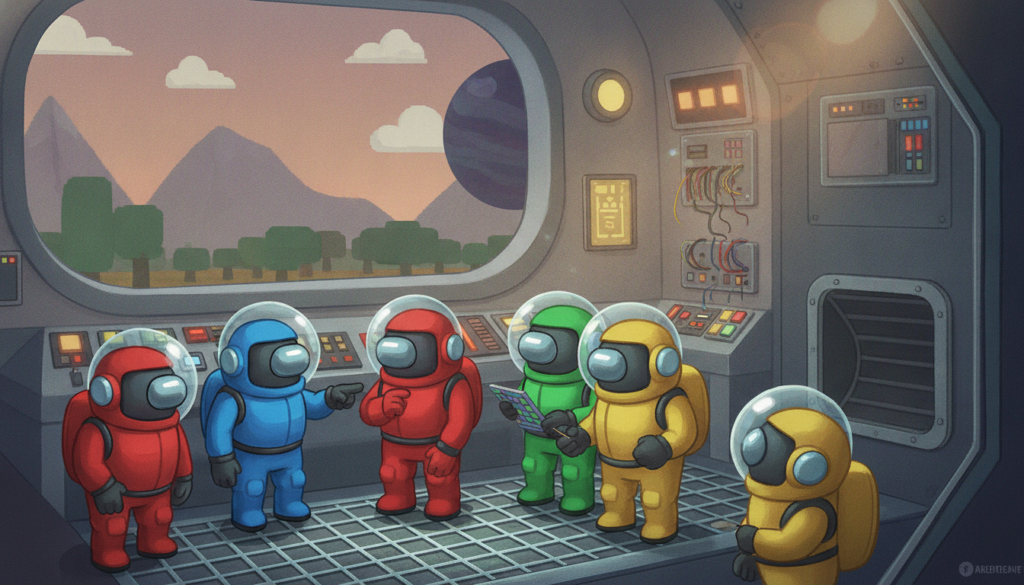
The game’s resounding success owes much to its minimalist, functional design. This choice wasn’t merely aesthetic; it was a smart game design decision intended to ensure an intuitive experience across any device.
Why the characters have no arms
The absence of arms on the crewmates might seem odd at first glance, but it serves a clear technical purpose. Without arms, the characters’ silhouettes become much cleaner and easier to recognize on small screens.
This simplification makes animation easier and prevents visual clutter from crowding the screen during tense moments. The focus remains on movement and environmental interaction, maintaining the clarity the player needs.
Color choices and quick identification
The use of vibrant, solid colors is a cornerstone of the game’s dynamic gameplay. In a chaotic environment where every second counts, quickly identifying who is who can mean the difference between victory and defeat.
Each color acts as a unique identifier, allowing players to process information in a split second. This makes Among Us‘s design highly effective, keeping the user’s attention focused on what truly matters: survival.
Secrets hidden in the classic maps
Have you ever stopped to notice the details hidden in Among Us maps while rushing to complete your tasks?
Often, the urgency of completing missions causes us to overlook visual elements that tell side stories about the crewmates’ work environment.
That’s why knowing every corner of these maps offers a tactical advantage that can determine the outcome of a match.
Details on The Skeld map
The Skeld is the game’s most iconic map, yet it hides details that often go unnoticed.
In several rooms, you can find personal items belonging to the crew—such as family photos and office supplies scattered across desks—which help humanize the ship and create the sense that the place was inhabited before the crisis began. What Lies Within Polus
Polus offers a vastly different atmosphere, serving as a research base on an icy, volcanic planet.
As you explore the Among Us maps, you will notice unique details in this location, such as biological samples and mining equipment.
The presence of lava and the geographic isolation heighten the constant tension players feel while traversing the outdoor corridors.
Visual Cues in Mira HQ
Mira HQ stands out for its modern, vertical design, reminiscent of a high-tech corporate office. The visual cues here are more subtle, focusing on complex control panels and windows that reveal the vastness of space.
Observing these elements helps one understand the facility’s hierarchy and layout, making navigation across Among Us maps far more intuitive for those who pay attention to detail.
The Psychology Behind Betrayal

Behind every act of sabotage lies a player trying to conceal their true intentions. Betrayal is the beating heart of this game, demanding keen skills in reading human behavior and maintaining emotional control.
Mastering the gaming psychology applicable to this environment is essential for anyone aiming to win. It is not merely about pressing buttons, but about understanding how people react under constant pressure.
The behavior of the novice Impostor
Players taking on the role of Impostor for the first time often display clear signs of nervousness; beginners frequently stand motionless near sabotage sites or avoid eye contact with other players on the map.
They also tend to tail other characters too closely, which immediately arouses suspicion. Over time, the player learns that acting naturally is their best ally in going unnoticed.
How Crewmates form false certainties
The average Crewmate often falls into mental traps during a match. Upon seeing a task being performed, they automatically assume the other player is innocent, overlooking the fact that certain actions can be faked.
This search for patterns of safety creates false certainties that benefit the traitor; maintaining a skeptical mindset is crucial, even when the evidence seems to point in an obvious direction.
- Blindly trusting someone who claims to have seen a visual task.
- Ignoring other players’ movement history.
- Accusing someone solely for being near a body, without proof.
- Forgetting that the map offers alternative routes for quick escapes.
The Art of Verbal Manipulation
Communication is undoubtedly the most powerful tool during emergency meetings. A skilled player knows how to use speech to divert attention or construct a convincing narrative regarding their own innocence.
Social deduction requires analyzing not just what is said, but how it is said. Tone of voice and response speed are valuable indicators for identifying who is trying to manipulate the group.
Mastering the art of persuasion turns any match into a complex strategic exercise. Those who can remain calm and articulate their arguments well usually dictate the pace of the final vote.
Conclusion
The success of Among Us proves that simplicity often masks fascinating complexity; it transcends the notion of a mere game, as it demands focus, the ability to read body language, and quick thinking in every round.
Each match aboard the spaceship offers a unique opportunity to test your powers of persuasion. By applying the strategies discussed, you transform the gaming experience into a continuous exercise in logic and social interaction.
Innersloth has created an environment where communication is the most powerful tool for survival. Leverage the knowledge you’ve gained to elevate your gameplay and surprise your teammates.