Anúncios
Survival is not merely a goal, but a daily challenge that demands difficult choices and careful planning.
Banished offers an immersive experience where every decision shapes the fate of your small community. Unlike other games, here you follow actual individuals who rely entirely on your strategic vision to thrive in a hostile environment.
Now, prepare to put your leadership skills to the test in a world where every mistake could come at a high cost to your people.
Anúncios
How survival works in Banished
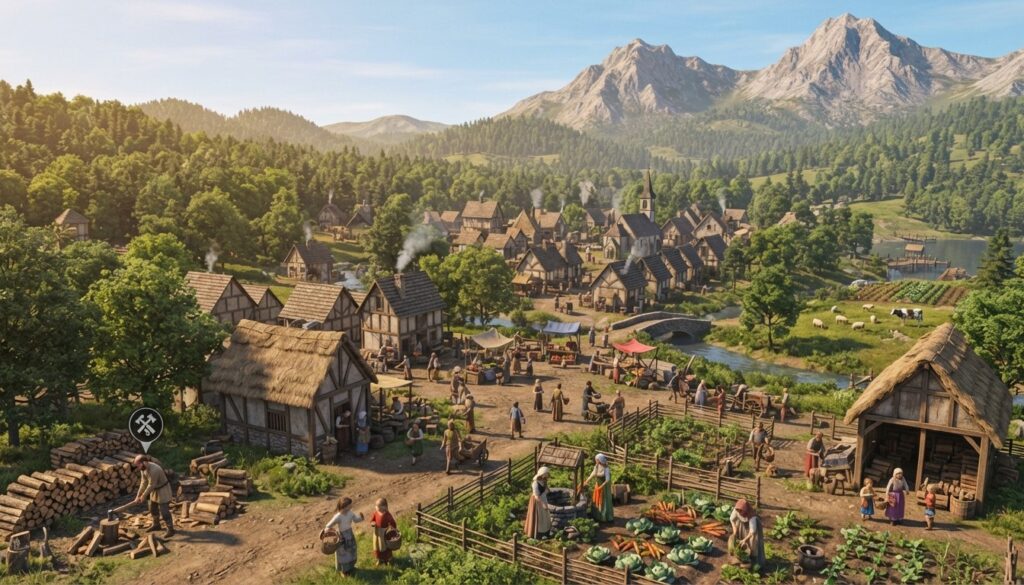
In Banished, the lives of your citizens are fragile and depend entirely on your strategic decisions.
The success of your settlement does not happen by chance; it is the result of rigorous planning that ensures the continuity of your small community’s lineage.
The importance of food, housing, and clothing
For your people to thrive, you must secure three fundamental pillars. Without them, survival becomes impossible, and the population quickly goes into decline.
Anúncios
- Food: Food production must be constant and diverse to prevent hunger.
- Housing: Homes provide shelter from the elements and allow families to grow.
- Clothing: Appropriate attire is essential for workers to endure intense cold.
Seasons and preparation for winter
The cycle of the seasons dictates the pace of work in the game. During spring and summer, all efforts should be focused on harvesting and storing resources.
Winter is a critical period when food production ceases almost entirely. If you have not stockpiled enough supplies before the first snowfall, your inhabitants will face a real risk of death from starvation or hypothermia.
Diseases, accidents, and other risks to inhabitants
Beyond hunger and cold, life in the countryside brings unexpected dangers. Workplace accidents can occur in mines or quarries, while diseases can spread rapidly if public health is neglected.
Maintaining a hospital or having a doctor available is a vital preventive measure. A lack of attention to healthcare can decimate entire families in just a few months of game time.
How to prevent a local issue from affecting the entire community
The key to stability is decentralization and efficient organization. Avoid concentrating all your resources in a single location, as a fire or an outbreak could destroy your entire stockpile at once.
Distributing warehouses and markets throughout the town helps keep the flow of supplies consistent. By closely monitoring the health and inventory levels in each sector, you ensure that a minor setback does not escalate into a catastrophe for the entire population.
Banished and building a town from scratch
Transforming a virgin plot of land into a functional home requires a keen eye for urban planning.
When starting a city from scratch, every decision made in the first few moments dictates the survival of your population. The key lies in balancing the need for expansion with the scarcity of immediate resources.
Choosing the site and utilizing natural resources
The first step is to analyze the map, looking for flat areas near water sources and dense forests. Proximity to timber and stone is vital, ensuring your inhabitants don’t waste precious time traveling long distances to gather materials.
A well-chosen site facilitates the extraction of essential raw materials. By positioning your hub of operations near these resources, you ensure that production begins without delay, protecting the community from the elements.
Layout of homes and organization of space
Spatial organization should prioritize proximity between residences and workplaces. If houses are too spread out, workers are forced to make exhausting journeys, which drastically reduces your colony’s efficiency.
Grouping dwellings into small clusters helps retain heat during the winter and provides easier access to basic services. This type of simple yet effective urban planning is what separates a thriving village from a settlement destined for failure.
Roads, warehouses, and efficient routes for workers
Building dirt roads is an inexpensive investment that speeds up the movement of your citizens. When workers can travel with agility, productivity increases and your supply stockpiles grow steadily.
Warehouses should be strategically positioned between production areas and residential zones, creating a logical flow of goods and ensuring that food and fuel reach those who need them quickly.
How to reduce travel and keep services accessible
To optimize city development, avoid creating industrial zones that are isolated from residential areas. Keeping workplaces—such as sawmills and firewood storage—close to homes reduces the time spent on unnecessary travel.
Always ensure that the paths between homes and food supplies remain clear. By keeping services accessible, you guarantee that your inhabitants have the energy to face daily challenges safely and comfortably.
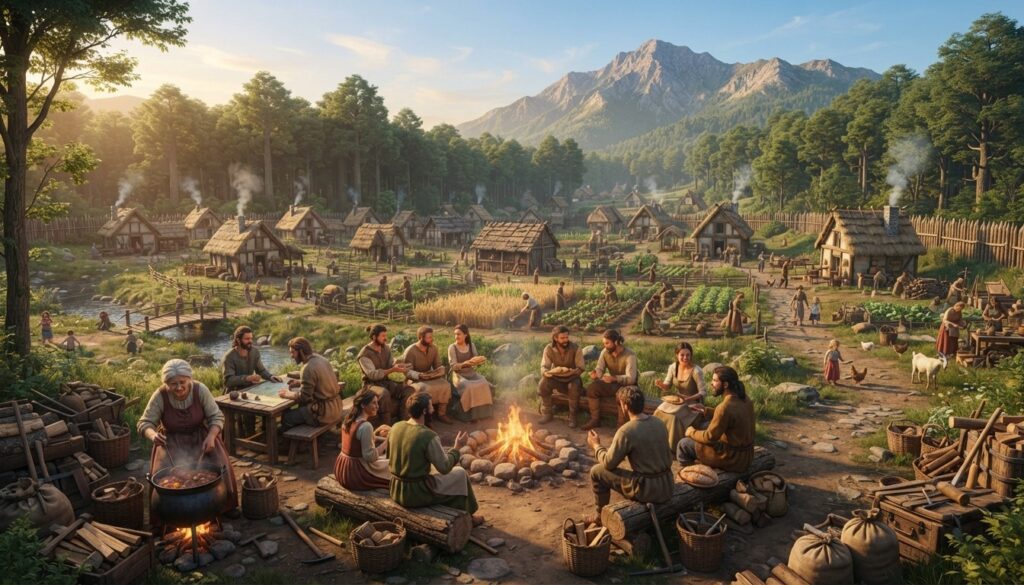
Inhabitants and Community Dynamics
Managing a community requires understanding that every inhabitant is a fundamental piece in the puzzle of survival. They are the driving force that keeps your village running—from gathering basic resources to constructing complex structures.
Essential Professions for Settlement Growth
For your settlement to thrive, you must assign specific tasks to each citizen. Professions range from farmers and woodcutters to blacksmiths and builders, with each playing a vital role in the production chain.
Without workers dedicated to these roles, the production of food and materials will quickly collapse; therefore, you must constantly monitor whether there are enough people in each sector to prevent shortages.
Families, Children, and Population Renewal
Population growth occurs naturally through the formation of new families. When young adults find an available home, they begin to have children, ensuring the continuity of your population.
Maintaining a steady influx of new inhabitants is essential to replace the elderly who eventually pass away. The balance between the number of homes and the number of people dictates the pace of this growth.
Education and the Development of More Efficient Workers
Education is a long-term investment that transforms children into highly skilled workers. By attending school, young people learn to perform their tasks much more efficiently than those who have not received such instruction.
Although the learning process takes time, the long-term benefits for the local economy are undeniable. Educated workers produce more resources with less effort, optimizing the use of available raw materials.
Balancing Available Labor with the Town’s Needs
You must always align the expansion of your town with the available labor force. Constructing new buildings without having enough people to operate them can create a dangerous imbalance in your management.
Constantly assess the actual needs of your people before embarking on major projects. Success depends on knowing when to expand and when to consolidate what has already been achieved.
Resources, production, and settlement administration
The survival of your people depends directly on how you manage the available resources.
The success of a growing city is tied to the efficiency of its resource management, ensuring that every inhabitant has what they need to endure the harshest seasons.
Wood, stone, and iron as the foundation for development
Progress begins with the basic collection of materials found in nature. Wood is essential for building homes and providing fuel for heating during the winter.
Stone and iron, meanwhile, are fundamental for upgrading your settlement’s structures. With these materials, you can erect more durable buildings and craft tools that boost worker productivity.
The production chain for food and materials
A well-structured production chain is the heart of your economy. It all starts with the collection of raw materials, which are subsequently transformed into vital consumer goods.
Food production must be consistent to prevent famine. You will need to organize fishermen, hunters, and farmers to ensure that food stocks are replenished before winter arrives.
Trade and the exchange of surpluses with merchants
When your city produces more than it consumes, trade becomes a strategic tool. Merchants visiting your port may offer rare items or seeds not found in the local region.
Trading surpluses is a smart way to diversify your economy; it helps maintain the stability of your production chain and allows you to acquire resources that would be difficult to obtain through local collection alone.
How to avoid waste and keep stocks protected
Efficient resource management requires constant vigilance over what is being stored. To prevent losses, follow these basic recommendations:
- Build warehouses near locations with the highest food production.
- Monitor inventory levels to avoid overloading storage spaces.
- Protect materials from the elements by using appropriate structures.
- Use trade to move products that are taking up too much space.
Conclusion
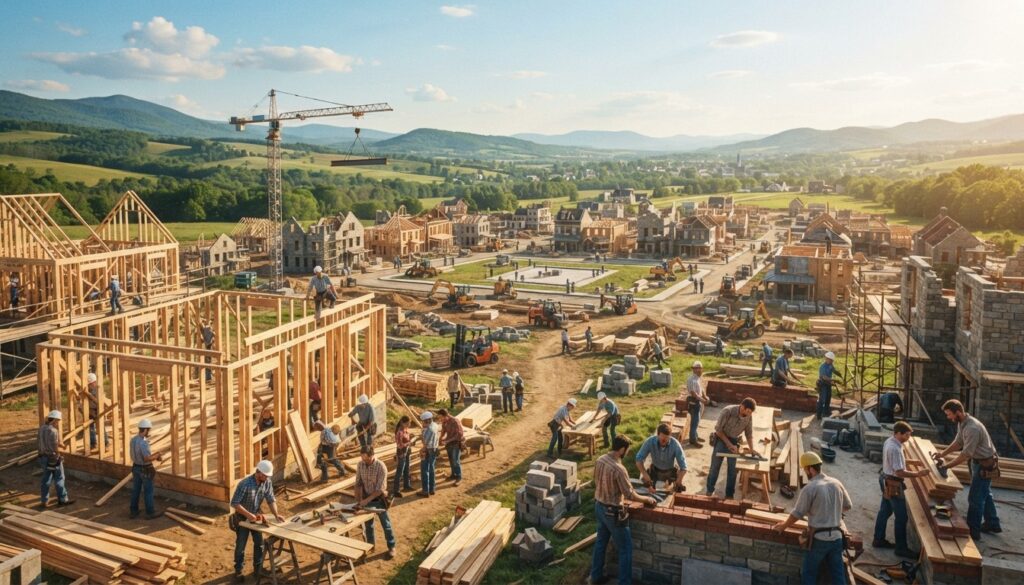
Mastering Banished requires more than just placing structures on the map. The true challenge lies in balancing immediate survival with the long-term vision needed to keep your population safe.
Every decision you make has a direct impact on the quality of life of your inhabitants. Success depends on your ability to manage scarce resources while contending with the harsh shifts of the seasons.
Transforming a small group of exiles into a self-sufficient community is a rewarding journey. Sustainable growth stems from patience and the careful planning of every route and stockpile.