Anúncios
Oxygen Not Included emerges as a fascinating challenge for those looking to put their leadership skills to the test.
In this space survival simulator, every cycle brings new dilemmas that challenge your ability to adapt and plan for the future.
Now, let’s explore together the essential mechanics that make this title an absolute benchmark in the strategy genre.
Anúncios
How the colony functions and the role of the duplicants

Managing a space colony requires understanding that every inhabitant is a unique individual with their own specific needs. These characters, known as “duplicants,” are the beating heart of any successful base.
They are not merely numbers on a spreadsheet, but beings that require constant attention. How you manage them determines the long-term success of your colony.
Who are the duplicants, and how do their traits influence the colony?
Each duplicant possesses a set of attributes that shapes their utility on the asteroid. Some are experts at excavation, while others have a natural aptitude for scientific research or cooking.
Anúncios
These characteristics determine which tasks they can perform with greater speed and efficiency. Consequently, ignoring these aptitudes can create a production bottleneck that undermines your entire resource management strategy.
Skills, personality traits, and individual needs
Beyond technical skills, each duplicant has personality traits that can be either positive or negative. Certain habits might boost work speed, while others could cause friction within the group.
They also have basic biological needs, such as sleep, food, and oxygen. Meeting these requirements is essential to maintaining productivity at acceptable levels.
When to accept a new duplicant—and when to decline
The game periodically offers the chance to bring new members into your base. However, accepting every candidate can be a fatal mistake for your progress.
Always evaluate whether your current infrastructure can support another mouth to feed and another set of lungs consuming oxygen. Turning away a new arrival is often the most strategic decision to ensure the survival of those already present.
Task distribution to avoid wasted time
Organizing work is a fundamental pillar for preventing your colonists from wasting time on unnecessary travel. Use the priority panel to ensure that each individual focuses on what they do best.
By delegating specific roles, you optimize resource management and ensure that critical tasks are completed promptly—preventing, for instance, a scientist from wasting time cleaning the floor.
Morale, stress, and the impact of the environment on performance
The surrounding environment directly influences the emotional state of your duplicants. Dirty, dark, or overcrowded spaces rapidly increase the team’s stress levels.
When stress reaches dangerous thresholds, duplicants may suffer nervous breakdowns and stop working. Therefore, maintaining high morale through decorations and comfort is essential for efficient and sustainable colony management.
Oxygen, temperature, and other vital resources
Survival in space depends on a delicate balance of basic elements. As you begin managing your colony, you quickly realize that every decision directly impacts the health of your duplicants.
The importance of producing and distributing oxygen
Oxygen is the most urgent resource for preventing your crew from suffocating. Installing oxygen generators is only the first step; efficient distribution requires careful planning of your base’s layout.
Without proper circulation, isolated areas can rapidly run out of breathable air. Monitoring atmospheric pressure levels ensures that every corner of the asteroid remains habitable.
Dealing with carbon dioxide and hazardous gases
The buildup of carbon dioxide is a common problem that can bring your duplicants’ work to a standstill. Since this gas is denser than air, it tends to settle in the lower levels of the base.
Identifying and removing toxic gases before they spread is essential for maintaining productivity. Using air purifiers and designing rooms intelligently helps keep the atmosphere clean.
Ventilation, filters, and the strategic placement of structures
Proper ventilation allows air to circulate freely between different areas. Strategically placing gas filters prevents pollutants from contaminating critical spaces, such as sleeping quarters and kitchens.
Positioning gas-emitting machinery away from rest areas is a simple yet highly effective tactic. This precaution prevents respiratory issues and keeps crew morale high.
Temperature as a Silent Threat to Survival
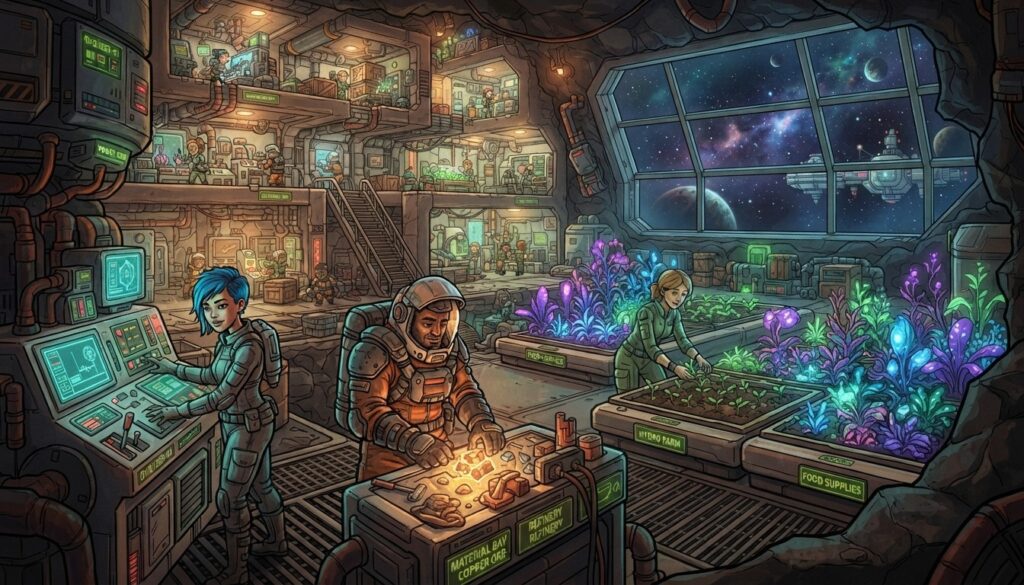
Temperature is a silent threat that can destroy crops and equipment without warning. Heat generated by industrial machinery accumulates gradually, turning safe areas into zones of thermal risk.
Controlling the internal climate requires the use of radiators and efficient thermal insulation. Ignoring this factor can lead to the overheating of vital components, triggering cascading failures throughout your infrastructure.
Water, Food, and Energy: The Pillars of Stability
Water, food, and energy form the foundation of stability necessary for long-term growth. A shortage of any of these essentials can disrupt the colony’s life cycle within just a few cycles.
Maintaining consistent production requires automation and constant monitoring of stockpiles. Efficiency in the use of these resources determines who thrives and who ultimately succumbs to a hostile environment.
Why an Emergency Reserve Can Save the Colony
Maintaining an emergency reserve is the best strategy against catastrophic, unforeseen events. Storing extra water and keeping batteries charged can be the difference between survival and total collapse.
These reserves ensure that the colony continues to function during technical failures or temporary shortages of raw materials. Planning for the worst-case scenario allows you to handle crises with much greater composure.
Building Efficient and Expandable Bases
Success in colony management depends directly on how you organize your space. Every decision made during the early cycles influences how easily your base can expand without descending into uncontrollable chaos.
How to Organize Spaces from the Early Cycles
Starting with a simple plan is the best way to avoid the need for rework. Try to keep essential resources near the center of the base to minimize travel time for your duplicants.
- Establish a central staircase axis to facilitate vertical access.
- Group power generators away from rest areas.
- Keep food supplies in cool, accessible locations.
- Set aside empty spaces for future machinery and technologies.
Separating sleeping quarters, bathrooms, kitchens, and industrial areas
Zoning is essential for keeping your duplicants’ morale high. By separating leisure and rest areas from noisy or polluted zones, you ensure a much more productive environment.
The impact of mess and foot traffic on duplicant routines
Accumulated filth and heavy traffic in narrow corridors can cause unnecessary stress. Therefore, keeping bathrooms and waste-processing areas isolated prevents germs from spreading throughout the colony.
Furthermore, wide corridors allow multiple duplicants to move around without getting blocked. Good circulation is a cornerstone of building a base that truly functions well in the long term.
Managing pipes, wires, and automation without turning your base into a maze
It is common for wiring and piping to end up as a confusing tangle. To avoid this, use utility corridors dedicated exclusively to the base’s infrastructure.
Automation is a powerful tool that, when applied effectively, reduces the need for manual intervention. By strategically placing sensors and switches, you can optimize energy consumption and ensure that systems only operate when necessary.
Vertical expansion and leveraging map features
The game map presents unique challenges that you can use to your advantage. Vertical expansion allows you to explore different biomes without needing an excessively wide base.
- Use natural cavities to install liquid storage tanks.
- Take advantage of temperature variations to cool or heat specific areas.
- Build transport bridges to efficiently connect distant regions.
- Adapt the layout as you discover new geological features.
Conclusion

Managing a colony in Oxygen Not Included requires a keen eye for every detail of the environment. Success depends on how well you integrate oxygen production, temperature control, and the well-being of your duplicants into a cohesive system.
Each playthrough offers a unique learning opportunity. You will find that common mistakes are simply part of the discovery process, serving as valuable lessons to refine your planning and resource management strategies.
Analyzing what went wrong allows you to make more confident and efficient decisions in your next attempt. The game’s complexity turns every challenge into a new chance to optimize your exploration.