Anúncios
Have you ever wondered what lurks in the shadows when no one is looking? Fear is a powerful sensation, capable of transforming ordinary settings into scenes of pure suspense.
This is the core premise of Little Nightmares II, a title that elevates the concept of survival to a new level. Prepare yourself for a journey where every step demands extreme caution.
Today, we will explore a twisted world filled with terrifying creatures and complex challenges.
Anúncios
Mono’s story and the encounter with Six.
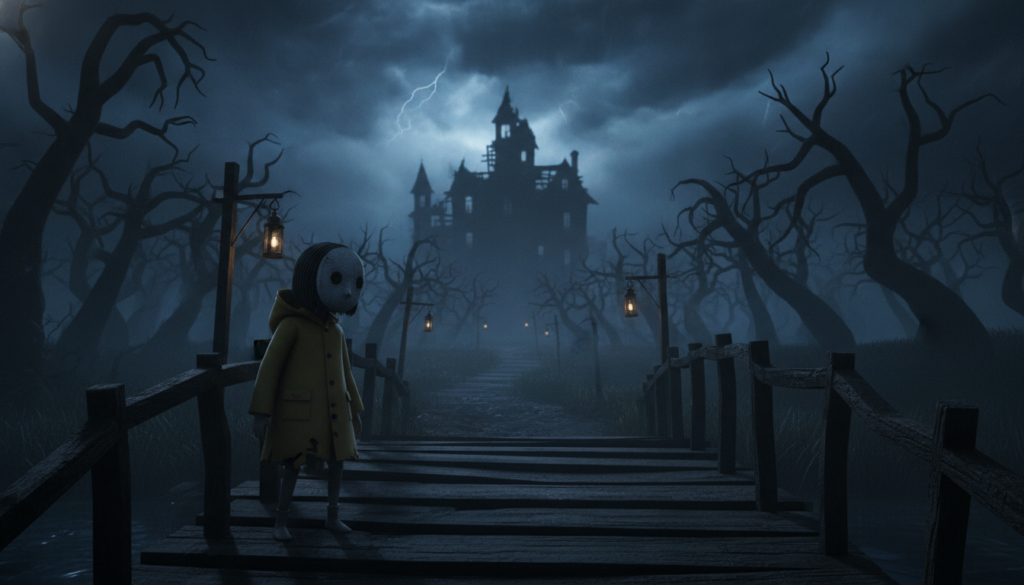
Mono emerges as an enigmatic protagonist, wearing a paper bag over his head and shrouded in mystery. He finds himself lost in a distorted world where reality seems to have fractured under an unknown external influence.
The protagonist Mono and his connection to the mysterious transmission
The boy is driven by a clear goal, even though the path ahead is fraught with obstacles. Mono feels an almost magnetic pull toward a distant tower, which appears to be the source of a mysterious transmission affecting everyone around him.
This connection is not merely physical; it seems to dictate the rhythm of his survival. As he explores the environments, he realizes that the mysterious transmission distorts the inhabitants’ perception, making the setting even more hostile for anyone attempting to traverse it.
Anúncios
Six’s role in the journey
Along the way, Mono encounters Six, a survivor who is already well-acquainted with the dangers of this place.
Six’s presence transforms the game’s dynamics, enabling the pair to tackle challenges that would be impossible to overcome alone.
Their partnership is crucial to making progress. Some of the key benefits of this collaboration include:
- Mutual assistance to reach elevated platforms.
- Collaborative solving of complex puzzles.
- Emotional support during moments of extreme tension.
- Protection against threats lurking in the shadows.
Following the narrative without spoiling key events
The story is told visually, without direct dialogue or explanatory text. Therefore, to understand what happens to Mono and his companion, you must observe the details scattered throughout the environments.
Every object and character reaction offers clues about the duo’s past and future. Staying focused on careful exploration ensures you absorb the plot’s full emotional weight without spoiling the surprises the game has in store.
The environments that make up the game’s distorted world
Every step taken in this distorted world reveals settings that challenge the explorer’s sanity. Game progression unfolds across distinct locations, each bearing a unique visual identity and a heavy emotional atmosphere.
These environments serve not merely as backdrops but as active elements that shape the tension. Transitions between them create a steady rhythm of fear and discovery.
The Forest and the sense of constant danger
The journey begins in a natural setting that hides dark secrets beneath dense vegetation. The Forest is a place where nature seems to conspire against the player, with traps scattered everywhere.
The silence is broken only by sounds suggesting a watchful presence; it is impossible to feel safe while traversing this treacherous, uncertain terrain.
The School and its threat-filled corridors
After leaving the wilderness, the path leads to an educational institution that twists the very concept of learning. The School features long corridors and classrooms that evoke memories of a rigid, oppressive past.
Every corner of this place hides dangers requiring agility and constant vigilance. The environment is claustrophobic, forcing the player to hide in lockers and narrow passages to survive.
The Hospital and the discomfort of its surroundings
The Hospital ratchets up the tension with an aesthetic evoking body horror and abandonment. The flickering lights and labyrinthine corridors create an immediate sense of visual discomfort.
In this setting, exploration becomes an act of courage, as any open door might reveal something disturbing. The atmosphere is heavy, making one’s presence there a truly harrowing experience.
The Pale City and the influence of screens on its inhabitants
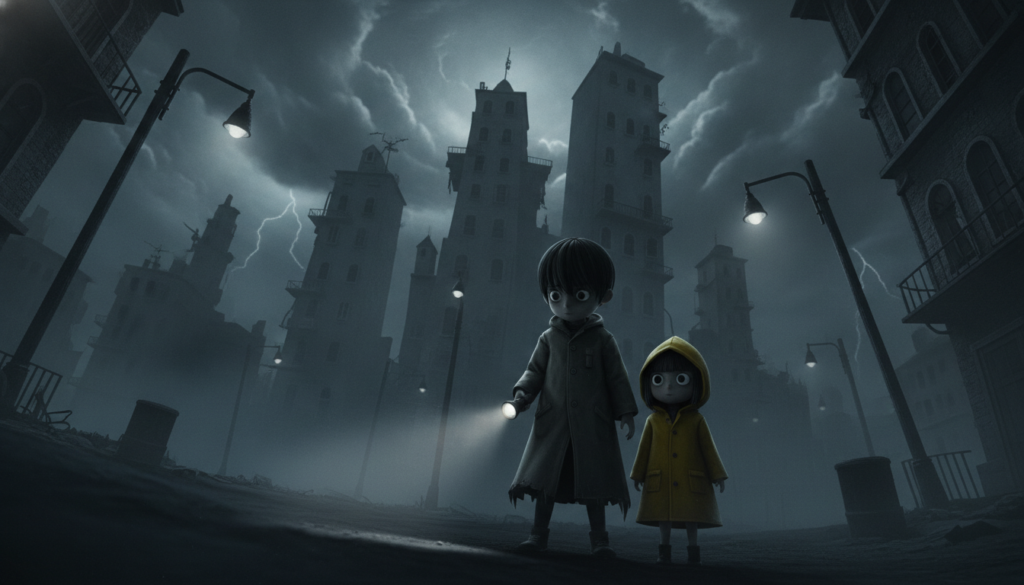
Finally, the Pale City emerges as the pinnacle of urban decay and alienation. The place is dominated by distorted architecture and the constant presence of screens that hypnotize its inhabitants.
The influence of these broadcasts creates an atmosphere of despair and apathy that permeates every street. Navigating this environment, therefore, requires understanding how technology and fear have merged to control the reality of that world.
Exploration, platforming, and puzzle-solving
Every setting in the game hides secrets that demand a keen eye and plenty of patience. Exploration is key to figuring out how to progress in a world where everything seems to be working against you.
Observing the environment to find the right path
Often, the solution for moving forward isn’t immediately obvious. You must analyze every detail of the rooms and corridors to spot alternative routes or hidden passages.
The game rewards those who take a moment to observe the lighting and surrounding objects. Subtle visual cues indicate where you can climb or interact with the environment to open up new paths.
Using objects, levers, and environmental elements
Interacting with the environment is essential for overcoming physical obstacles. You will encounter levers, keys, and movable items that must be positioned correctly to create platforms or access points.
These elements require you to think creatively about the available space. Sometimes, an ordinary object can be the tool needed to reach a high ledge or unlock a sealed door.
Challenges requiring attention and trial-and-error
The journey is non-linear, and certain moments require you to test different approaches. Don’t be afraid to fail; every mistake teaches you something new about how the game’s puzzles work.
Persistence is a virtue for anyone wishing to unravel the mysteries of each chapter. With patience, you’ll find that the logic behind the challenges becomes clearer as you grow more familiar with the mechanics.
Why the puzzle pacing complements the suspense
The measured pace of the puzzles helps keep tension high. As you try to solve a problem, the silence and heavy atmosphere create a constant sense of vulnerability.
This blend of reflective moments and the need for quick action makes for a highly immersive experience. The game strikes a perfect balance between the quiet of exploration and the urgency of escaping unexpected threats.
The terrifying creatures and dangers of each chapter
The world of Little Nightmares II is inhabited by terrifying creatures that constantly test your limits.
The journey demands constant vigilance, as danger lurks in every shadow, turning exploration into a test of survival.
The Hunter and the threat in the outdoor areas
Early on, you encounter the Hunter, a solitary figure who dominates the outdoor areas; he uses his shotgun to eliminate anyone who dares cross his path, forcing the player to hide amidst the dense vegetation.
The Teacher and her unpredictable movements
Inside the school, the Teacher stands out due to her watchful nature and extendable neck. Her movements are swift and unpredictable, making navigating the hallways a challenge that requires patience and precise timing.
The Hospital patients and body horror
The Hospital is undoubtedly one of the adventure’s most unsettling locations. Here, you face patients afflicted by extreme body horror; they move in bizarre ways and react only to the light of your flashlight.
The Teacher and the disturbing behavior of the city’s inhabitants
In the Pale City, the Teacher and other inhabitants display disturbing behavior, often appearing hypnotized by broadcasts.
They ignore the world around them, focusing solely on their own dark impulses and an incessant quest for control.
How enemies influence tension and player strategy
Each encounter requires a shift in your survival strategy. Rather than direct combat, the game encourages silent observation and strategic flight to avoid confronting these threats.
Tension mounts as you learn each enemy’s patterns—particularly in the Hospital. Consequently, mastering these mechanics is essential to progressing and unraveling the mysteries surrounding this dark universe.
Conclusion
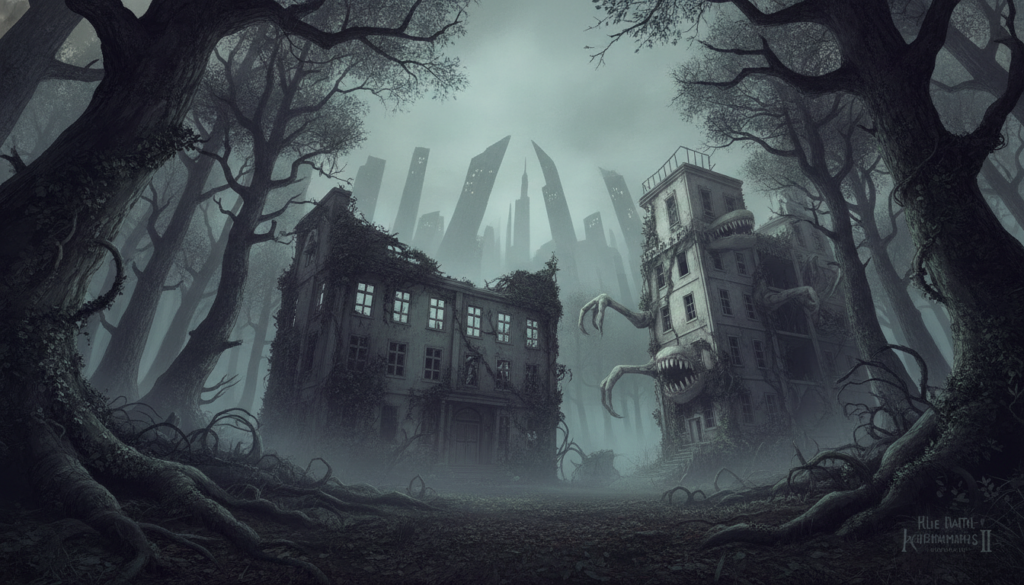
Little Nightmares II delivers an experience that lingers in the memory long after the controller is put down. The blend of dark art direction and silent storytelling creates a world where every detail tells a disturbing story.
The gameplay evolves organically as Mono and Six face constant dangers. This balance between exploration and tense moments defines the adventure’s pacing.
The emotional bond between the protagonists makes the journey even more impactful for those seeking high-quality psychological horror. That is why it is worth exploring every corner of this twisted universe to uncover all its hidden secrets.